
Price for plywood exported from Russia to China contracted 22%.
Price for plywood exported from Russia to China contracted 22%.
Price for plywood exported from China rose 1.2%.

Compared with the previous month, production was up 14%.

Prices were up 6.8% from a year earlier while Canada's broader factory-gate prices were up 12.4% year over year.

Higher pulp prices, strong renewable fuel demand and growth in advanced materials supported results, while weak graphic paper demand, high wood costs and geopolitical uncertainty continued to weigh on parts of the business.
Compared with the previous month, production was down 1.1%.
The U.S. Department of Commerce retained the 187.27% dumping margin, while permanent antidumping and countervailing duty orders will depend on a final U.S. injury ruling.
Antidumping deposits remain in place for entries made from March 2, while final duties depend on the U.S. International Trade Commission’s injury determination.
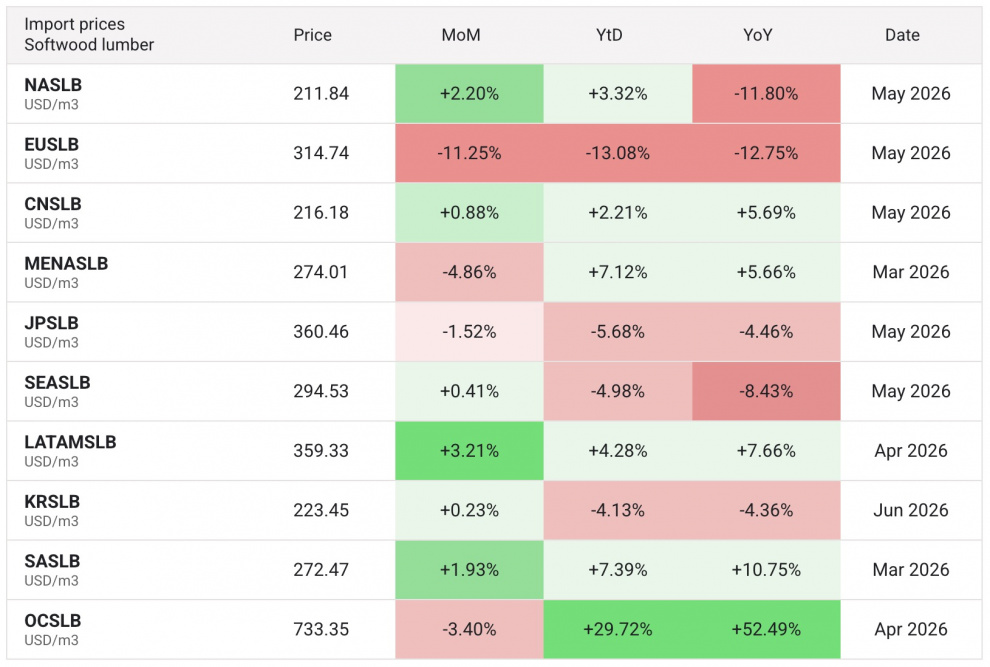
Update introduces regional import-price benchmarks, producer prices and PPI, a multi-series chart builder and an Analytics Data API subscription.

The Finnish Financial Supervisory Authority has approved WISA Group Plc’s demerger and listing prospectus.

Price for plywood imported to the EU increased slightly 0.1%.

Industrial analyzers combine machine vision with deep learning to improve recovery and reduce waste across veneer, plywood and LVL manufacturing.

The new category will allow around 30 to 40 custom cutters and processors in the province to access a dedicated share of BC Timber Sales timber supply previously reserved for other value-added manufacturers.

Price for plywood imported to Taiwan upped 3%.
The industry estimate puts chemical inputs at up to 40% of particleboard costs.

Price for plywood exported from Chile decreased 13%.
Family-owned company founded in 1954 cites wood supply challenges and foreign competition.

Tropical Storm Arthur damage and the 56-year-old facility make repairs uneconomic; officials will meet employees about transfers and the mill will stop after remaining inventory is processed.

Price for plywood exported from Malaysia to the U.S. increased 6%.
Price for plywood exported from Cambodia to the U.S. slipped 3%.