Japan’s new Forest and Forestry Basic Plan targets domestic construction wood use of 23 million m3 in 2030, up from 18 million m3 in 2024, and 26 million m3 in 2035. The plan also targets total domestic wood supply of 40 million m3 in 2030 and 42 million m3 in 2035, compared with 35 million m3 in 2024, according to the Ministry of Agriculture, Forestry and Fisheries.
The total wood demand forecast is 85 million m3 for both 2030 and 2035, down from the previous plan’s 87 million m3 forecast for 2025. Domestic wood use is targeted at 40 million m3 in 2030 and 42 million m3 in 2035.
The increase in domestic construction wood use comes as Japan’s imports of softwood logs continue to decline. In January-June 2026, imports fell 7.5% year on year to 826.0 thousand m3, while the value of imports decreased 10.3% to $197.0 million. The average import price fell 3.0% to $238.5 per m3.
Annual softwood log imports fell from 12,241.5 thousand m3 in 2000 to 1,645.9 thousand m3 in 2025, a decline of 86.6%, according to Lesprom Analytics. Imports fell below 2,000 thousand m3 in 2023 and remained below that level in 2024 and 2025, at 1,945.7 thousand m3, 1,717.7 thousand m3 and 1,645.9 thousand m3, respectively.
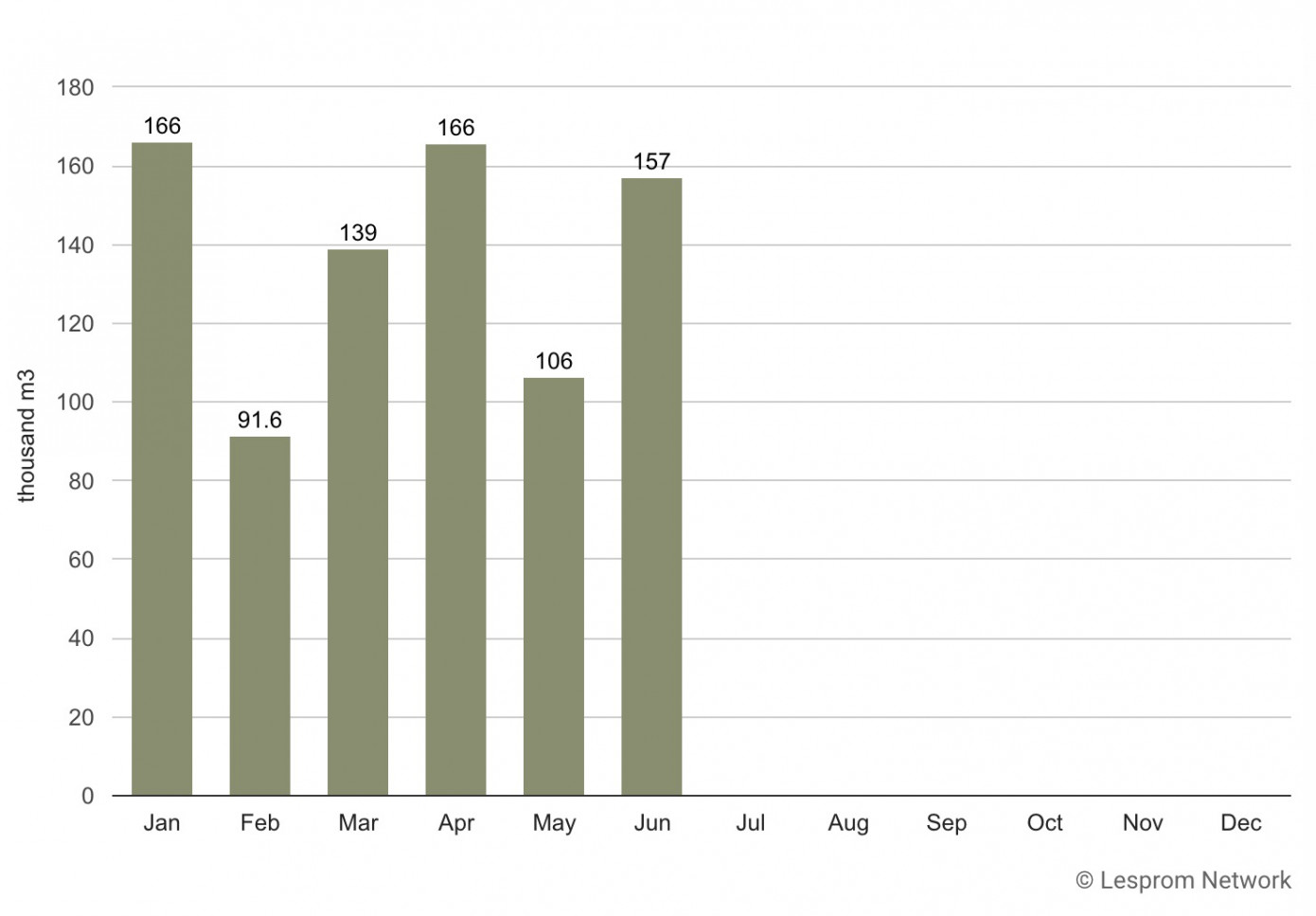
Image: Japan’s softwood log imports, January-June 2026 / Lesprom Analytics
Within domestic construction wood, use of sawlogs for lumber is targeted at 18 million m3 in 2030, up from 14 million m3 in 2024, and 20 million m3 in 2035. Domestic plywood use is targeted at 5 million m3 in 2030 and 6 million m3 in 2035, compared with 4 million m3 in 2024.
Non-construction domestic wood use is planned to remain at 17 million m3 in both 2030 and 2035. Domestic pulp and chipwood use is targeted at 4 million m3 in both years, while fuelwood use is planned to rise from 12 million m3 in 2024 to 13 million m3 in 2030 and remain at 13 million m3 in 2035.
The plan targets domestic roundwood deliveries to sawmills and plywood mills of 21 million m3 in 2030, up from 16 million m3 in 2024. Mill productivity is targeted at 800 m3 per worker per year in 2030, compared with 600 m3 in 2023.
For housing, the plan targets a domestic wood share of 60% in 2030, compared with 50% in 2024. It also targets domestic construction wood use of 23 million m3, equivalent to a 70% domestic share, through wider use in non-residential and mid- and high-rise buildings.
The government plans to increase forest aggregation and consolidation for forestry operators to 2.1 million ha by 2030, from 1.6 million ha in 2023, an increase of about 31%. The plan also aims to zone two-thirds of planted forests as areas suitable for forestry. The measures include forest consolidation, road development, reforestation and the use of remote sensing, AI and other forestry technologies to strengthen domestic timber supply.