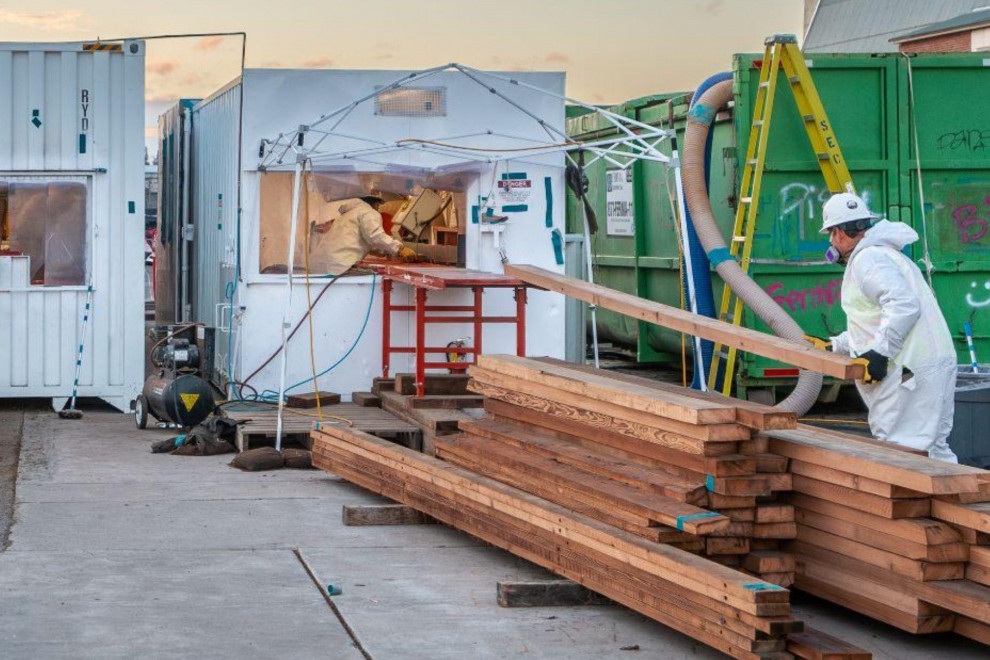
Google recovered approximately 119,000 board feet of Douglas-fir lumber, weighing 178 tons, during the deconstruction of Hangar 3 at Moffett Field in California. Some of the material will be used in an Oregon mass timber office project, including planned glulam columns, CLT assemblies and architectural applications, according to Google.
Hangar 3 was built in 1943 to house airships for coastal defense. The structure used nearly three million board feet of Douglas-fir and stood for more than 80 years before deconstruction began in 2023 and finished in 2025.
Engineering assessments found that the hangar could not be saved after decades of environmental exposure, seismic loading and material fatigue. Traditional demolition was not used because it would have disrupted the site and created risks from historic contaminants.
The salvage process focused on lumber that could be safely recovered after testing for fire-retardant chemicals, creosote and other contaminants. Crews processed the wood on site, usually planing off a quarter inch from each side, and used QR codes to track grouped material back to its original location in the hangar.
Part of the recovered wood has already been used in Google’s real estate portfolio. The Moffett Park Green Link Bridge in Sunnyvale used 4,750 board feet as a decorative facade, while Creekside in San Jose used 1,200 board feet as finish cladding on commercial modular units.
The company sent additional material to Mercer Mass Timber in Spokane, Washington, for grading, machine stress rating and manufacturing evaluation. About 66,000 board feet met dimensional and grading criteria for potential use in glulam and CLT panels.
For the project in The Dalles, Oregon, Mercer Mass Timber is fabricating glulam columns with reclaimed lumber for final testing by Washington State University. The columns will use about 6,000 board feet of reclaimed wood.
A larger quantity, about 44,000 board feet, has been incorporated as an architectural face and bottom layer of a CLT assembly. The assembly is designed as a structural three-ply panel made with virgin lumber, while the reclaimed Hangar 3 wood will serve as a visible nonstructural layer.
Construction is scheduled for fall and winter 2026-2027, after final testing and city and county approval. The remaining material is being reserved for other nonstructural uses, including millwork.